Introduction
THE NIGHT ELVIS REFUSED TO FADE: How One Devastating Performance of “Hurt” Revealed the Fighter Still Inside the King
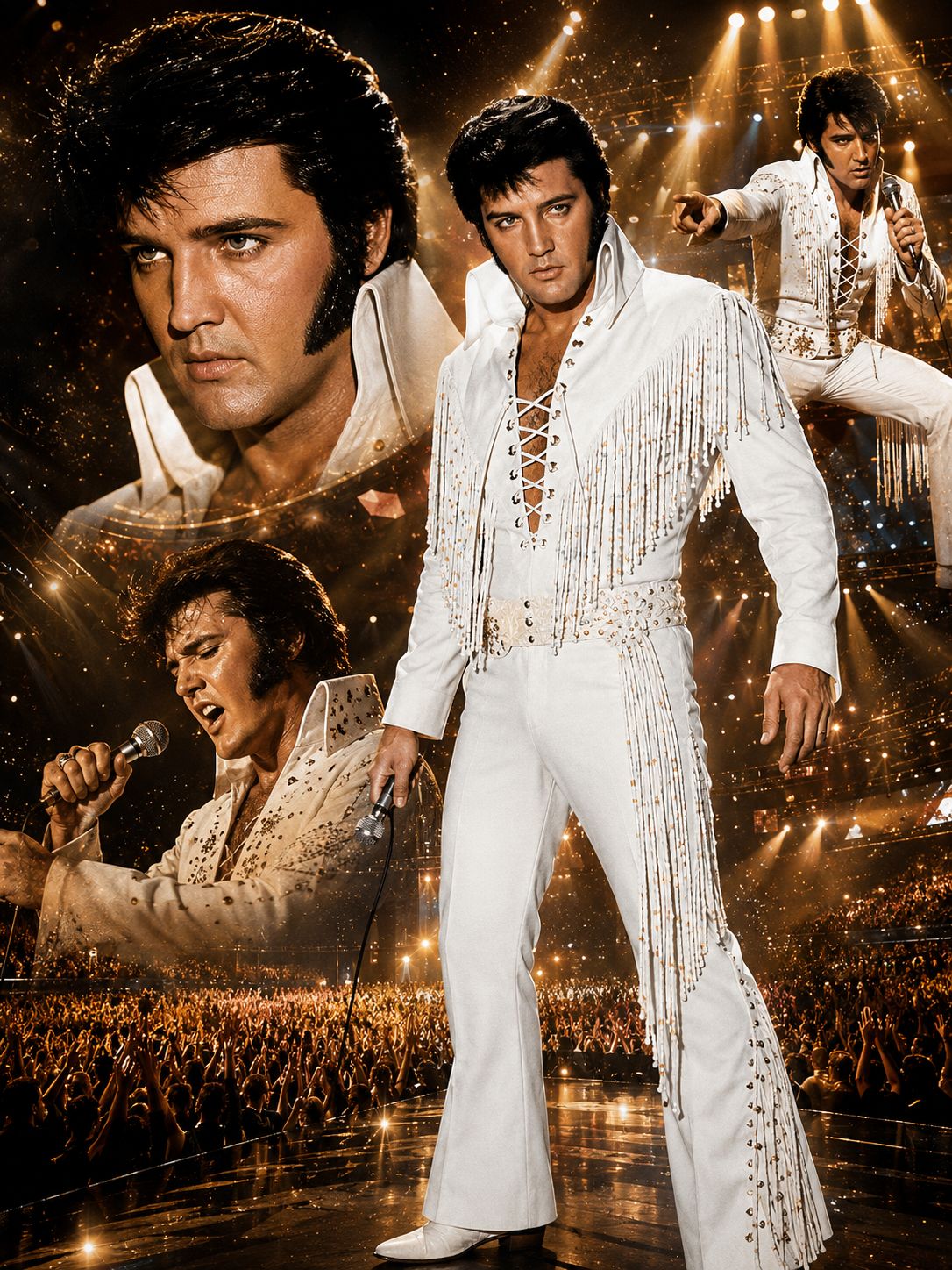
History has a tendency to preserve legends at their most magnificent. We remember the perfect photographs, the triumphant entrances, the records that changed everything, and the nights when greatness appeared effortless. With Elvis Presley, those images are almost impossible to escape: the young revolutionary shaking American popular culture in the 1950s, the black-leather figure reclaiming his throne in 1968, and the commanding entertainer standing before an international audience during Aloha from Hawaii. Yet there is another Elvis whose performances can be even more difficult—and perhaps more moving—to watch. He is the Elvis of 1977, a man whose physical struggles were becoming increasingly visible, but whose voice could still suddenly remind everyone why the title King of Rock and Roll had once seemed completely inadequate to describe his power.
On June 19, 1977, Elvis walked onto the stage at the Omaha Civic Auditorium in Nebraska while CBS cameras documented the concert for what would eventually become the television special Elvis in Concert. The Omaha show included songs from across his career, including “That’s All Right,” “Are You Lonesome Tonight?,” “Jailhouse Rock,” “How Great Thou Art,” “Hurt,” “It’s Now or Never,” and “Can’t Help Falling in Love.” Concert recordings confirm that “Hurt” arrived late in the program, shortly before the evening moved toward its conclusion.
Watching or listening to that period of Elvis’s career requires a certain honesty.
This was not the Elvis of 1956.
It was not even the Elvis of 1970.
By the summer of 1977, he looked tired, and the strain surrounding his life could no longer be disguised simply by stage lighting or an elaborate jumpsuit. The extraordinary schedule he had maintained for years, combined with serious health difficulties and the pressures of remaining Elvis Presley every moment he appeared in public, had taken a visible toll. Contemporary reactions to these final filmed concerts have often been uncomfortable precisely because the cameras captured both the greatness and the vulnerability of the man standing in front of them.
And yet something remarkable happened whenever the right song found him.
“Hurt” was one of those songs.
The composition had existed long before Elvis recorded it, but in his hands it became a formidable vocal showcase. It demanded control, range, dramatic instinct, and above all the willingness to push toward a conclusion that sounded almost larger than the melody itself. Elvis had recorded his version during the final phase of his career, and by 1977 it had become one of those numbers audiences waited for because it gave him an opportunity to demonstrate that enormous voice.
In Omaha, the surrounding circumstances made it feel different.
The opening lines carried restraint, but the intensity gradually increased. Elvis leaned into the melody with the instinct of a singer who understood that “Hurt” could not merely be performed; it had to be inhabited. His voice became more forceful as the song climbed, and suddenly the man critics were describing as diminished seemed capable of producing moments of astonishing authority.
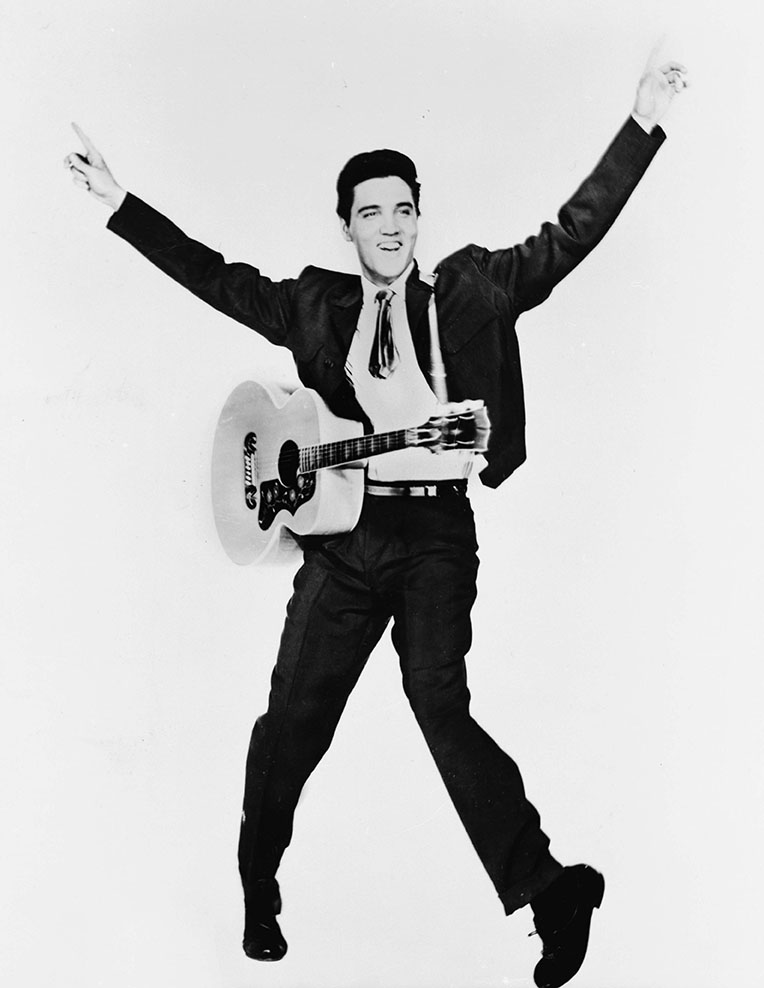
For a few minutes, the conversation changed.
The question was no longer what Elvis had lost.
The question became: How could that voice still be there?
Even assessments that have been highly critical of the overall Elvis in Concert material have singled out performances such as “Hurt” and “How Great Thou Art” as evidence that his vocal power could still emerge dramatically during this difficult final period.
That distinction matters because Elvis’s final months are too often presented as a simple story of decline.
Real life is rarely that tidy.
A human being can struggle and still possess extraordinary talent. A performer can be physically diminished and still produce a note capable of stopping an audience cold. A career can be nearing its end without the artist understanding that the ending is close.
Elvis Presley in June 1977 embodied all of those contradictions at once.
The Omaha concert was not his final performance. Two days later, on June 21, cameras recorded another show in Rapid City, South Dakota, also used for the eventual CBS production. His last concert would come on June 26 in Indianapolis. But Omaha occupies a particularly haunting place in the story because the television cameras preserved Elvis without the protective distance that memory later created.
Viewers could see the struggle.
They could also hear the voice.
That is why “Hurt” resonates so profoundly when revisited today.
Older fans who remember Elvis during his lifetime do not need to be persuaded that the man had changed. They watched that transformation happen. They remember the impossibly handsome young performer appearing on television screens in the 1950s. They remember the Army years, the Hollywood years, the comeback, Las Vegas, Madison Square Garden, Hawaii, and finally the troubling photographs and reports of his last tours.
For those listeners, Omaha can feel less like watching a celebrity fail and more like watching an old champion refuse to stop fighting.
There is dignity in that.
Not because suffering should be romanticized.
Not because every late Elvis performance deserves to be called magnificent.
But because on certain songs, something inside him still responded to the challenge.
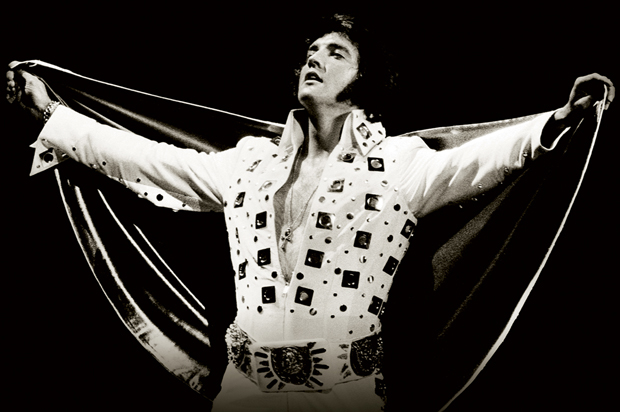
“Hurt” demanded everything Elvis had left to give vocally, and for those brief minutes, he gave it.
The moment also reveals something essential about what made Elvis more than merely a charismatic entertainer. His greatest weapon had never been the jumpsuits, the famous movements, the sideburns, the jewelry, or even the mythology surrounding his name.
It was the voice.
That voice could move between Rock and Roll, Country, Blues, Gospel, and dramatic balladry without losing its identity. It could sound youthful and rebellious, then vulnerable, spiritual, commanding, or deeply weary. By 1977, age was not the issue—Elvis was only 42—but life had changed the instrument. There was greater heaviness in it, sometimes greater strain, but also a depth that the twenty-one-year-old Elvis could never have possessed.
That depth gave “Hurt” an uncomfortable emotional authenticity.
The young King had once made greatness look effortless. The Elvis standing in Omaha had to fight for it.
And when “Hurt” reached its climactic moments, that fight became audible.
For those few extraordinary minutes, Elvis Presley did not defeat time, illness, exhaustion, or fate. No singer could.
He accomplished something more human.
He stood beneath the lights, gathered what remained of that enormous voice, and reminded everyone listening that the artist who had changed music was still there.
The body could show its wear. The headlines could question him. Time could close in. But when Elvis Presley opened his voice and attacked “Hurt,” the King had not surrendered yet.